Category Archives: Advocacy

Establishing International Multi-Center Collaboration on Antiaging and Disease Prevention

May 15, 2020

On May 15, representatives of 15 research institutions from 13 countries established an International Multi-Center Collaboration on Antiaging and Disease Prevention by signing a memorandum of understanding (MoU).

The collaboration will include representatives from the Institute of Basic Medical Sciences Chinese Academy of Medical Sciences & School of Basic Medicine Peking Union Medical College, China (Dr. Robert Chunhua Zhao); International Society on Aging and Disease, USA (Dr. Kunlin Jin); University of Valencia, Spain (Dr. Antonio Cano); University of Nice, France (Dr. Eric Gilson); University of Palermo, Italy (Dr. Calogero Caruso); Maharishi Markandeshwar Deemed University, India (Dr. Sasanka Chakrabarti); King’s College London, UK (Dr. Georgina Ellison-Hughes); European Academy of Sciences, Arts and Humanities, France (Dr. Ante Glibota); University of Toronto, Canada (Dr.  Armand Keating); University of Hong Kong, China (Dr. Lee Wei Lim); Syktyvkar State University, Russian Federation (Dr. Alexey Moskalev); Inha University, Republic of Korea (Dr. Kyung-Jin Min); University of Macau, China (Dr. Huanxing Su); Vetek (Seniority) – the Movement for Longevity and Quality of Life, Israel (Dr. Ilia Stambler); Karolinska Institutet, Stockholm, Sweden (Dr. Brun Ulfhake). 

This collaboration followed the establishment of the Executive Committee on Anti-aging and Disease Prevention in the framework of Science and Technology, Pharmacology and Medicine Themes under an Interactive Atlas along the Silk Roads, UNESCO. The committee inauguration took place during the 2nd (Beijing) Annual International Biomedical Health Conference and the 1st Academician Forum of Transnational Biomedical Field, in Beijing, on December 16, 2019[1]. The committee members outlined collaboration opportunities among the institutions involved. The resulting international collaboration will focus on Anti-aging and Prevention of both communicable and non-communicable diseases. This will advance an integrative and preventive approach to diseases as it considers aging processes as the major risk factors of both communicable and non-communicable diseases that need to be addressed by prevention and therapy. The recent evidence of the strong risks of unfavorable outcomes among the elderly and frail COVID-19 patients further emphasizes the validity of this approach and the need for international cooperation in this area. [2]

The collaboration will advance international academic research, innovation and knowledge exchange in relation to:

  • Data sharing for research and development around detection, treatment and prevention of degenerative aging and aging-related diseases, their prevalence, risk factors, evaluation criteria and effective counter-measures.
  • Building working groups around strategic areas of antiaging and disease prevention to select diagnostics and interventions for further development.
  • Implementing projects, publications and meetings around risk factor assessment, regulation/policy, education, diagnosis and interventions for antiaging and disease prevention.
  • Creating academic and public awareness about the role of aging and its amelioration in both non-communicable and communicable diseases. Thus, beside the traditional emphasis on the relation of aging and non-communicable diseases such as heart disease, neurodegenerative diseases, diabetes mellitus, cancer, COPD, etc., this collaboration will also advance the understanding about the role of aging processes and their amelioration in communicable diseases, such as COVID-19. The latter goal will include exploring and advancing therapies that show promise to improve the underlying aging processes, such as the immune function of the elderly, e.g. utilizing mesenchymal stem cells.

This collaboration will be open for additional parties to join at any time for the duration of the collaboration. We hope that this collaboration will contribute to finding and deploying effective measures for ameliorating degenerative aging processes and prevention of aging-related diseases threatening the global society.


[1] Robert Chunhua Zhao and Ilia Stambler (2020). The urgent need for international action for anti-aging and disease prevention. Aging and Disease, 11(1), 212-215. https://doi.org/10.14336/AD.2019.1230

See also materials at the International Society on Aging and Disease (ISOAD) http://www.isoad.org/

[2] Zikuan Leng, Rongjia Zhu, Wei Hou, Yingmei Feng, Yanlei Yang, Qin Han, …, Ilia Stambler, Lee Wei Lim, Huanxing Su, Alexey Moskalev, Antonio Cano, Sasanka Chakrabarti, Kyung-Jin Min, Georgina Ellison-Hughes, Calogero Caruso, Kunlin Jin, Robert Chunhua Zhao (2020). Transplantation of ACE2- mesenchymal stem cells improves the outcome of patients with COVID-19 pneumonia. Aging and Disease, 11(2), 216-228. https://doi.org/10.14336/AD.2020.0228
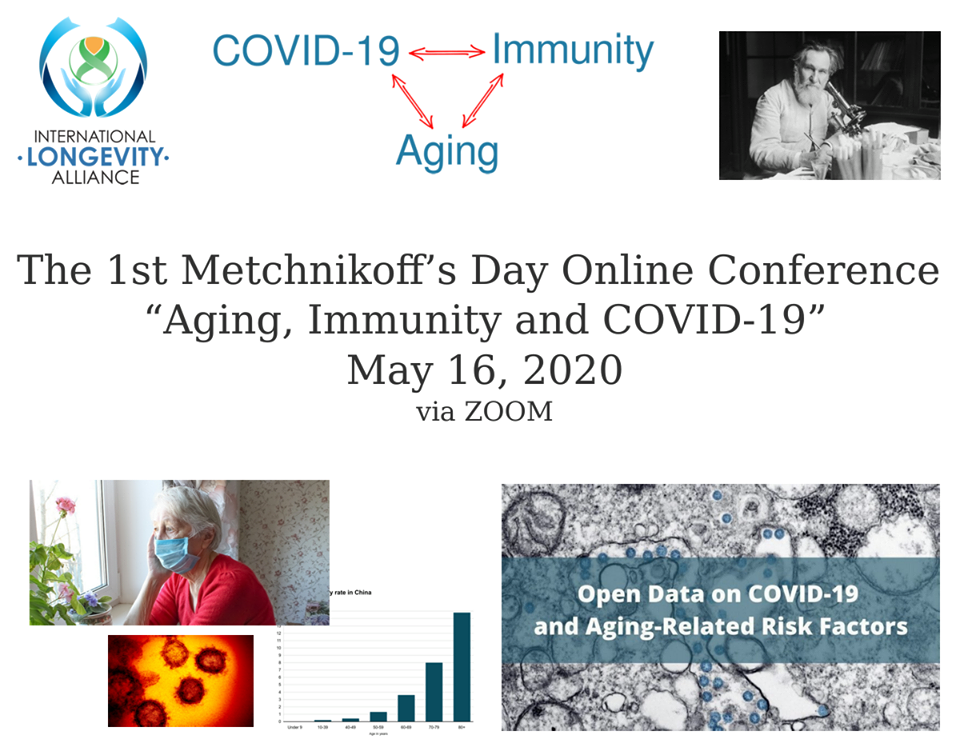
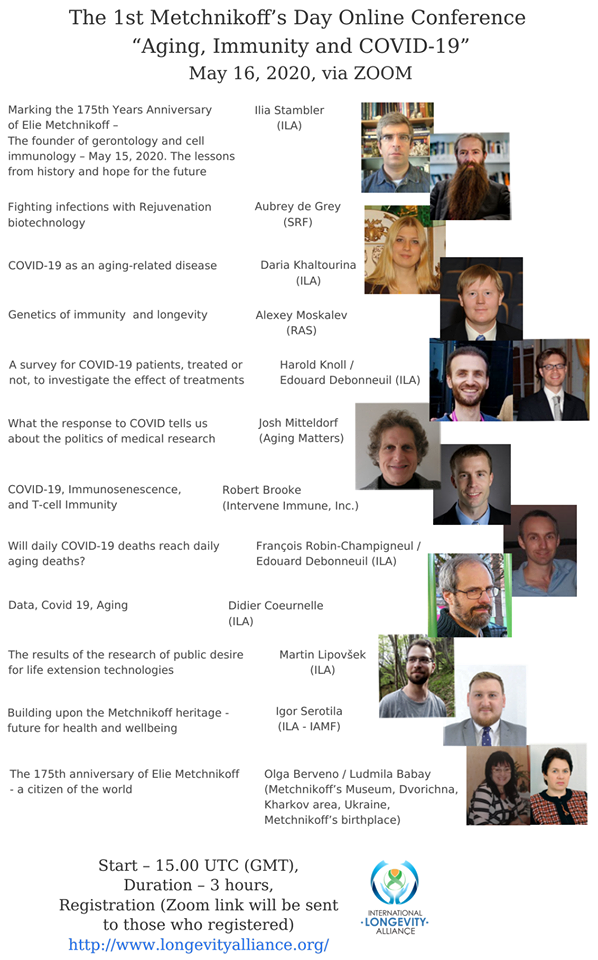
Metchnikoff day – May 15. Online conference – May 16

Metchnikoff Day Poster 1

The 1st Metchnikoff’s Day Online Conference 

“Aging, Immunity and COVID-19”

May 16, 2020

Via ZOOM

Time (tentative, may be updated): 8am PST, 11am EST,  15pm GMT, 17pm CET, 18 pm IST/MST.

The online conference is dedicated to celebrating the 175th anniversary of Elie Metchnikoff, the founder of gerontology and cell immunology (May 15, 1845-July 15, 1916). The conference will foster academic and public discussion on how biological research of aging and longevity could help tackle COVID-19 pandemics and improve the control of aging-related communicable and non-communicable diseases. 

We will advocate for the strong enhancement of the research of aging-mediated immune deficiency as a major risk factor for disability and mortality. It is established that elders have a much greater risk of dying from COVID-19 than young people. While the average mortality rate from COVID-19 among known cases in Hubei, China, was 0.2% until the age of 40 y.o., it was 14.8% among people over 80 y.o. COVID-19 is thus a disease opportunistically associated with aging. Hence ameliorating degenerative aging processes appears to be the most promising way to protect patients, especially the elderly, to reduce their disability and mortality. 

The conference will emphasize this connection. The International Longevity Alliance holds annual events on Metchnikoff’s Day to promote longevity research and advocacy around the world. 

Attendance is open and free, yet registration is requested.

Registration form (ZOOM link will be sent to the registered attendants in advance).

https://docs.google.com/forms/d/e/1FAIpQLSfdmp_2Uhp7ZYQRRAwu604I0s_g3B8A9QpeFG-Roaboh3CElA/viewform

In addition, the conference will be streamed on facebook, from the ILA group

https://www.facebook.com/groups/longevity.alliance/

The recording is on youtube

https://youtu.be/oDqCYjT1pkA

The Program

http://www.longevityalliance.org/?q=1st-metchnikoff-s-day-online-conference-aging-immunity-and-covid-19-may-16-2020

METCHNIKOFF CONFERENCE PROGRAM MAY 16

Facebook event

https://www.facebook.com/events/237031744174376/

Event poster

https://www.facebook.com/InternationalLongevityAlliance/photos/rpp.308167409309579/2752709588188670/?type=3&theater

See also events and materials from Metchnikoff’s day celebrations in 2015, on Metchnikoff’s 170th anniversary

http://www.longevityforall.org/170th-anniversary-of-elie-metchnikoff-the-founder-of-gerontology-may-15-2015/

Presentations for Metchnikoff’s 175th anniversary

English

Russian


We Call for Open Anonymized Medical Data onCOVID-19 and Aging-Related Risk Factors

Open Data on COVID19We hereby call on WHO and country leaders for maximum openness of medical data from patients with the coronavirus SARS-CoV-2, to enhance medical research and the development of new therapies and treatment regimens against this world-threatening disease. Especially, we demand more research and development to therapeutically address aging as the main contributing factor for disability and deaths in this disease, for example to improve the immunity in older people. Data openness is necessary to facilitate such research and achieve safe, effective and accessible therapies, as soon as possible, to combat COVID-19 and other diseases that have aging as the main risk factor. Support this initiative! Sign the petition!

http://chng.it/cLwkxSsP 


The full text of the petition can also be found in the links:

Open Longevity: http://eng.openlongevity.org/open_letter_to_who_covid19

International Longevity Alliance (ILA): http://www.longevityalliance.org/?q=we-call-open-anonymized-medical-data-covid-19-and-aging-related-risk-factors

Please share on Facebook

4th International conference on Aging and Disease – ICAD2021 – Beijing, Oct. 29-Nov 1, 2021

logo-isoadThe 4th International conference on Aging and Disease (ICAD 2021) of the International Society on Aging and Disease will be held at China National Convention Center, Beijing, China, from October 29 to November 1, 2021 (postponed from the original plan for 2020). 

The International Society on Aging and Disease (ISOAD; www.isoad.org) is a non-profit organization comprised of people from many countries and various professional disciplines engaged in research and training in the fields of aging and aged-related disease. The mission of ISOAD is to improve health and quality of life by stimulating research focused on understanding the biological linkage between aging and disease. 

The 4th ICAD meeting strives to accomplish this by gathering professionals in disparate fields to provide new insights into such linkages. We believe that this conference will provide a platform that will help to fill the current gap between studies of the basic biology of aging and of aged-related disease. We expect that about 1,500 scientists, physicians and students from all over the world to attend.

Among its diverse scientific and social activities, the conference will also host the work of the recently founded UNESCO Committee on Anti-aging and Disease Prevention

http://www.aginganddisease.org/article/2020/2152-5250/ad-11-1-212.shtml

Detailed information about the conference, including the venue, confirmed speakers, program, call for papers, and registration, can be found at:  http://www.isoad.org/Data/List/Conference

 We look forward to seeing you in Beijing, China, from October 29 to November 1, 2021!

On behalf of the International Society on Aging and Disease (ISOAD)

www.isoad.org


UNESCO Committee on Anti-Aging and Disease Prevention is established in Beijing!

logo-isoadThere is a growing consensus that researching and developing therapeutic interventions into degenerative aging processes is a necessary condition for improving the health and longevity of the rapidly aging global population Thus, the research and development of therapies against degenerative aging processes (anti-aging) and for prevention of major aging-related diseases is a necessary condition for alleviating the severe economic, healthcare and humanitarian challenges of the global aging society. And therefore, promoting the research and development in the field of anti-aging and aging-related disease prevention is becoming an urgent national and international task. How can the field of anti-aging and disease prevention be promoted globally to solve the challenge of bringing effective, safe and accessible anti-aging and preventive therapies to the world as soon as possible? A significant further step was taken toward the solution of this challenge with the establishment of the new Executive Committee on Anti-aging and Disease Prevention, a joint effort of UNESCO and China World Peace Foundation. 

The Executive Committee on Anti-aging and Disease Prevention was established in the framework of Science and Technology, Pharmacology and Medicine Themes under an Interactive Atlas along the Silk Roads, UNESCO. The committee inauguration took place during the 2nd (Beijing) Annual International Biomedical Health Conference and the 1st Academician Forum of Transnational Biomedical Field, in Beijing, on December 16, 2019 (http://www.isoad.org). 

See more details about the establishment of the UNESCO committee in the report of the International Society on Aging and Disease – ISOAD (one of the main co-organizers of the UNESCO committee) in Aging and Disease, the journal of the International Society on Aging and Disease, entitled:

“The Urgent Need for International Action for Anti-aging and Disease Prevention”

Aging and Disease, 2020, 11(1): 212-215

http://www.aginganddisease.org/article/2020/2152-5250/ad-11-1-212.shtml

And related news:

The next major gathering of the UNESCO Committee on Anti-Aging and Disease Prevention will take place during the 4th International Conference on Aging and Disease (4th ICAD) of the International Society on Aging and Disease (ISOAD) that will be held at China National Convention Center, Beijing, China, from October 30 to November 2, 2020.

This will be a high level gathering of leading experts from many countries and various professional disciplines engaged in research and training in the fields of aging and aged-related disease. The mission of ISOAD is to improve health and quality of life by stimulating research focused on understanding the biological linkage between aging and disease. This conference will further advance this mission and provide a platform that will help to fill the current gap between studies of the basic biology of aging and of aged-related disease. We expect that about 1,500 scientists, physicians and students will attend from all over the world.

Detailed information about the conference, including the venue, confirmed speakers, program, call for papers, and registration, can be found at:  http://www.isoad.org/Data/List/Conference 

We wish the new UNESCO Committee on Anti-Aging and Disease Prevention the best of success in its vitally important mission!

And we look forward to seeing you in Beijing, China, from October 30 to November 2, 2020!

On behalf of the International Society on Aging and Disease (ISOAD)

www.isoad.org

Organizing the Longevity Month Campaign for October 2019

Longevity Day and Month Generic

As every year since 2013, about three months ahead, we start preparing for the Longevity Month campaign in October (also commonly designated as “Longevity Day” for particular daily events during October). This traditional campaign has combined the activities of many organizations and individual activists working to promote research, development and application for healthy longevity around the world. During the years, hundreds of events, publications and other promotional actions were organized in dozens of countries in the framework of this campaign. These activities help build up the longevity activism into a massive global grassroots movement with a sizable impact on public health and research policy.

Here are some examples of the past activities. https://www.longevityforall.org/longevity-day-and-longevity-month-october-2018/

This year too, we invite you to organize longevity-related events, publications and promotions during the month of October, advocating to enhance research, development and education for the promotion of healthy longevity and prevention of aging-related diseases.

If you organize or participate in an event, publication or promotion in your country, please contact us, so we could present and combine the events together as a united global campaign.  Thank you for your support and involvement!

longevityalliance@googlegroups.com

longevityforallinfo@gmail.com


Vetek (Seniority) – the Movement for Longevity and Quality of Life (Israel)

Vetek - Vertical - Post

Due to the aging of the global population and the derivative increase in aging-related non-communicable diseases and their economic burden, there is an urgent need to promote biomedical research and development on aging and aging-related diseases as a way to improve healthy and productive longevity for the elderly population. This task is urgent for every country. And indeed, the World Health Organization posited in its 13th Programme of Work for 2019-2023 that “Ensuring healthy ageing is an urgent challenge in all countries”.

Israel shares in the problem and seeks to contribute to solutions via diverse initiatives and organizations. In order to help address the aging-related health challenges, Vetek (Seniority) – the Movement for Longevity and Quality of Life, is uniquely poised to advance biomedical aging and longevity research in Israel. Advised by leading Israeli and international scientists in diverse fields of biomedical aging and longevity R&D, supported by noted public figures and advocates, strategically situated and connected in the Israeli and international scientific and civic establishment – it advances the scientific research and development for the achievement of healthy longevity in Israel and internationally.

The association’s main areas of interest include: education and awareness, raising public awareness about biomedical research and development dedicated to improve healthy longevity of the elderly population, improving the scientific, medical, social and institutional perception of the field; communication and support, providing assistance in recruiting support for the most promising and effective diagnostic and therapeutic R&D approaches, from specific R&D projects to establishing R&D programs and centers of excellence, connecting researchers in the field of biomedical research of aging and adjacent areas and other stakeholders; analysis and data processing, examining the entities active in the field in Israel and abroad, performing evaluation of R&D approaches to diagnosis and treatment, and providing recommendations regarding the most promising R&D directions, including data collection, curation, access, analysis, integration and sharing in the field of aging and longevity research.

Recent actions of the Vetek association included co-initiating in cooperation with the “Disabled Not Half a Person” association, a special section for “Enhancing the research, development and education for the promotion of healthy longevity and prevention of aging-related diseases” as a part of the preparation of the Israel National Masterplan on Aging and co-organizing discussions in Knesset on this subject in 2018.

http://www.longevityisrael.org/knesset-hearing-on-research-development-and-education-for-the-promotion-of-healthy-longevity-and-prevention-of-aging-related-diseases/

http://www.longevityisrael.org/special-discussion-of-the-knesset-committee-on-science-and-technology-for-the-first-time-for-the-strengthening-of-research-and-development-for-improving-the-quality-of-life-and-longevity-and/

Forthcoming actions include co-organizing the conference “International Perspectives in Geroscience – Israel” which will take place in the Weizmann Institute of Science on September 4-5, 2019, in cooperation with such organizations as American Federation for Aging Research (AFAR), the US Nathan Shock Centers of Excellence in the Basic Biology of Aging and others.

http://www.longevityisrael.org/international-perspectives-on-geroscience-israel-4-5-september-2019/

Generally the Vetek (Seniority) – the Movement for Longevity and Quality of Life works to enhance longevity research and advocacy not only in Israel, but internationally and for that purpose forms strategic partnerships with like-minded organizations in Israel and abroad. It has formed a particularly strong strategic partnership with Israeli Longevity Alliance (ISRLA) jointly orgnaizing national and international conferences on longevity science, petitioning the decision makers and organizing events and publications in support of the longevity field. Currently the two associations share the same scientific advisory board composed of leading Israeli and international geroscientists, the same website http://www.longevityisrael.org/ and jointly perform most of the actions. Yet, in Israel, the Vetek association also formed a strategic partnership with “Disabled Not Half a Person” association jointing advocating for longevity research, development and education. Internationally, the organization cooperates with the International Society on Aging and Disease (ISOAD), the International Longevity Alliance (ILA), Longevity International, American Federation for Aging Research and other longevity research and advocacy organizations.

The association strives to further intensify its research and advocacy activities for the promotion of healthy longevity, in Israel and internationally.


Longevity Day and Longevity Month – October 2018

Longevity Day and Month

(Updated November 1, 2018)

As every year since 2013, we organize the campaign: International Longevity Day (October 1) and/or International Longevity Month (October) in support of biomedical research of aging and longevity. In the past 5 years, hundreds of events, meetings, publications and promotions in dozens of countries were held as a part of this campaign.

Also this year, excellent events were organized as a part of the Longevity Month campaign in October, including: 

1. France

The conference of the International Society on Aging and Disease on October 5-7 in Nice

http://www.isoad.org/Data/List/Conference

2. Spain 

Transvision 2018 on October 19-21 in Madrid

http://transvisionmadrid.com/

3. Israel

Awareness campaign – Healthy Longevity through research and development (throughout October).

http://www.longevityisrael.org/longevity-month-israel-october-2018/

A conference at the Weizman Institute of Science “Promoting Longevity: Targeting Aging and Age-related Diseases”

4. Belgium

Announcing the results of the Longevity Film Competition (organized by HEALES, SENS Research Foundation and ILA) on October 1 https://longevityfilmcompetition.com/

http://www.longevityalliance.org/?q=longevity-film-competition-until-september-15th

5. Russia

The international school “Mechanisms of Aging and Age-Related Diseases” – Moscow Institute of Physics and Technology from September 30 to October 3

https://biomembranes2018.ru/program/satellite-events/

6. Italy

Senior Expo. Prevention and Family. Cosenza. October 4,5,6

https://www.facebook.com/events/643160249394686/

7. Bulgaria

The conference on Vanguard Scientific Instruments in Management (VSIM) in Ravda, on September 11-16, including a section on longevity and future technologies, with a following promotion and declaration during the International Longevity Day – October 1.

http://vsim-conf.info/en/

8. Pakistan

An awareness campaign organized by the Pakistan Aging Research Society (PARS) and the National Academy of Young Scientists (NAYS)

https://www.facebook.com/events/525281527894931/

9. Cyprus

As a part of the Longevity Day/World Day of Older People Celebrations, The Rotary Club of Larnaca held an event on Tuesday 02/10/2018 at 8pm, at Sun Hall Hotel, Larnaca. 
10. Ukraine
A mini-seminar on aging research was held in Kiev, on September 30, as a part of the Longevity Day celebrations.
11. Romania
A meetup in Bucharest on October 14
12. UK
Anti-aging conference London. October 11-13
13. Brazil
On line promotion by NeuroPod


Here are some exemplary events, promotions and publications from the past 5 years of this campaign. 

https://www.facebook.com/LongevityDay/

http://www.longevityforall.org/longevity-day-and-longevity-month-october-2017/

If you organize an event, meeting, publication or any other kind of promotion – please share your plans, so this year too we can create a sizeable public awareness campaign in support of aging and longevity research, development and application.

Ilia Stambler

Longevity for All


Aging is now included into the WHO work program. Thanks!

whologoDear friends,

Following the previous extensive discussion and the recent WHO Executive Board Meeting that was completed on January 27, I felt it was necessary to provide an update on the campaign that many longevity activists were conducting for the inclusion of aging health into the WHO work program.

Briefly: Congratulations, the longevity activists have won!

Thanks to the international advocacy campaign, WHO now has included a strong focus on “healthy aging” into the new WHO draft work program.

See the latest work program draft in English and all the 6 UN official languages (as of January 2018)

http://www.who.int/about/what-we-do/gpw-thirteen-consultation/en/

http://apps.who.int/gb/ebwha/pdf_files/EB142/B142_3-en.pdf?ua=1

See especially paragraphs 15, 16, 17, 37, including the WHO commitment to advance the Global Strategy and Action Plan (GSAP) on Ageing and Health (until 2020, including the strategic objective 5 for “improving measurement, monitoring and understanding of healthy ageing”) and to prepare for the Decade of Healthy Aging (2020-2030).

Perhaps the most significant for advocacy is that Paragraph 17 of the work program declares that “Ensuring healthy ageing is an urgent challenge in all countries” and Paragraph 15 declares the major public health goal “to live not just long but also healthy lives” and suggests the use of “healthy life expectancy” as the main measure of health care success. Such goals and measures for healthy longevity can be advocated and quoted also at the national and local level.

Further, WHO published the specific targets and indicators of the WHO 13th General Programme of Work (GPW) 2019-2023. The main target for advancing aging health in the WHO work program is: “Reduce the number of older adults 65+ yrs who are care dependent by 15 million” – from the estimated baseline of 180 million in 2017 to 165 million in 2023. The data are to be evaluated through national population surveys, though the measurements of “care dependence” and distributions by countries and regions are not clear. Yet, as the program states, “Agreed impact indicator framework [is] under development prior to the Decade for Healthy Ageing 2020-2030”. This can provide further justifications to advance healthy longevity as well as an item for consultation and reporting, nationally and internationally.

So thanks again to everybody who participated in the campaign to include aging health into the WHO work program for your contribution! Here the head of the WHO Ageing and Life Course division acknowledges the importance of this campaign for the change of the program, and quotes the article “Aging health and R&D for healthy longevity must be included into the WHO work program” as an example of the successful joint advocacy effort.

https://twitter.com/DrJohnBeard/status/938418218473082881

http://www.aginganddisease.org/EN/10.14336/AD.2017.1120

Hopefully, this advocacy will continue, to ensure healthy longevity is not just planned, but actively advanced and implemented. If you organize or are involved in further longevity advocacy campaigns – either for specific topics (like the one for the WHO) or specific dates and occasions – please share your plans and actions, so we could coordinate together and create a stronger impact!

Thankfully,

Ilia Stambler, PhD

Chairman. Israeli Longevity Alliance (ISRLA). Chief Science Officer. Vetek (Seniority) Association – the Senior Citizens Movement (Israel)

http://www.longevityisrael.org/

Outreach coordinator. International Society on Aging and Disease (ISOAD)

http://www.isoad.org/

Coordinator. Longevity for All

http://www.longevityforall.org/


Advocate to include aging health into WHO Work Program – Update

Aging - 90 Percent 1An update on the issue of the exclusion of the subject of aging health and any measures for its improvement from the WHO Work Program for 2019-2023. An advocacy campaign has been taking place to introduce these issues into the WHO Work Program, via the open public consultation that WHO now conducts about the program. It is really easy to participate in the consultation, to tell the WHO that aging health is important and R&D for healthy longevity is important. Any one can do it right now via this link:

http://www.who.int/about/gpw-thirteen-consultation/en/

Some backgrounds on the WHO work program and this advocacy campaign:

http://www.aginganddisease.org/EN/10.14336/AD.2017.1120

http://www.isoad.org/Data/View/745

http://www.longevityforall.org/aging-is-excluded-from-who-work-program-please-react/

https://www.facebook.com/longevityforall/posts/1466226320080764

Now the update (as of November 25, 2017):

It looks like our joint advocacy efforts so far with the WHO had some effects. About 90% of the responses (of over 400 by Nov. 19 and more are coming in) were about the lack of aging in the WHO program. And following those comments, as the “proposed action” WHO apparently plans to commit to including WHO’s earlier “Global Strategy and Action Plan on Aging and Health – GSAP” in its work program (including GSAP strategic objective 5 “Improving measurement, monitoring and research on Healthy Ageing”).

(Of course, that is just partial information, mainly according to the WHO Presentation

http://www.who.int/mediacentre/events/2017/executive-special-session/executive-board-slides.pdf?ua=1

https://www.facebook.com/photo.php?fbid=10155224996319001&set=a.10151164471979001.443216.609694000&type=3&theater&ifg=1

It is still too early to make any definite conclusions. We will still need to watch the process for the long run, and respond accordingly.)

But apparently some contribution was made. Thank you very much for your involvement and effort!

That is just a start. We can still advocate with WHO for the strong emphasis on aging health and R&D for healthy longevity through May 2018 (when the work program is submitted to the WHO assembly).

Even now you are welcome to continue responding to the WHO consultation, and emphasize the importance of aging health and biomedical aging research, as the deadline was again extended through Nov. 29, if you have not yet done sohttp://www.who.int/about/gpw-thirteen-consultation/en/

Please also spread the word (also in the media and social media, as mass media ignores this topic, even though this issue relates basically to everybody). We have to make the need to promote aging health overwhelmingly clear to WHO (>95%)! 

In particular, please see: The joint position statement, entitled “Aging health and R&D for healthy longevity must be included into the WHO Work Program” published in Aging and Disease. 9(1):1-3, 2018. Available on line:

http://www.aginganddisease.org/EN/10.14336/AD.2017.1120

http://www.isoad.org/Data/View/745

The signatories include leaders of the International Society on Aging and Disease (ISOAD), American Federation for Aging Research (AFAR), International Federation on Ageing (IFA), International Association of Gerontology and Geriatrics – IAGG (European Region and Asia-Oceania), International Longevity Center – Australia, The Gerontological Society of the Russian Academy of Sciences, African Society for Ageing Research and Development (ASARD), Israeli Longevity Alliance/Vetek (Seniority) Association (Israel).

You may consider some of the points raised in that position statement, and are welcome to reference this document in your advocacy efforts!

Thanks again!

Ilia Stambler, PhD

Outreach coordinator. International Society on Aging and Disease (ISOAD)

http://www.aginganddisease.org/EN/10.14336/AD.2017.1120

http://www.isoad.org/Data/View/745

Chairman. Israeli Longevity Alliance. CSO. Vetek (Seniority) Association – the Senior Citizens Movement (Israel)

http://www.longevityisrael.org/

Longevity for all

http://www.longevityforall.org/aging-is-excluded-from-who-work-program-please-react/

https://www.facebook.com/longevityforall/photos/a.781457785224291.1073741828.668820539821350/1478935032143226/?type=3&theater

Further update (as of December 7, 2017).

Concretely, it looks like the WHO intends to amend the draft Work Program to include the clause “Reduce the number 65+ who are care dependent by 15 million”.

That is just a preliminary notion. Yet even this notion appears to be encouraging. Of course, this is not a strong impact objective, considering there are hundreds of millions of elderly whose care dependence needs to be improved, also thanks to developing better therapies and technologies through biomedical research of aging. But it may be a good start for introducing the objective of improving aging health, also for national advocacy efforts — considering that originally the issue was not in the WHO work program at all, and was introduced thanks to the international advocacy campaign!

Update January 9, 2017

Indeed, thanks to the international advocacy campaign, WHO has included a focus on “healthy aging” into the new WHO draft work program (the advance version was published on line on January 5, in the link below). See especially paragraphs 15, 16, 17, 37, including the WHO commitment to advance the Global Strategy and Action Plan (GSAP) on Ageing and Health (until 2020, including the strategic objective 5 for “improving measurement, monitoring and understanding of healthy ageing”) and to prepare for the Decade of Healthy Aging (2020-2030).

Perhaps the most significant for advocacy is that Paragraph 15 of the work program declares the major public health goal “to live not just long but also healthy lives” and suggests the use of “healthy life expectancy” as the main measure of health care success. Such goals and measures for healthy longevity can be advocated and quoted also at the national and local level.

http://www.who.int/about/what-we-do/gpw13-expert-group/Draft-GPW13-Advance-Edited-5Jan2018.pdf?ua=1

So thanks again to everybody who participated in the campaign to include aging health into the WHO work program for your contribution! Here the head of the WHO Ageing and Life Course division acknowledges the importance of this campaign for the change of the program, and quotes the article “Aging health and R&D for healthy longevity must be included into the WHO work program” as an example of the joint advocacy effort.

https://twitter.com/DrJohnBeard/status/938418218473082881

http://www.aginganddisease.org/article/0000/2152-5250/147696

Hopefully, this advocacy will continue to ensure healthy longevity is not just planned, but actively advanced and implemented. Let us see what is finally decided at the WHO Executive Board meeting on January 22-27 about the program and the place of healthy longevity and R&D for healthy longevity in it. http://www.who.int/about/what-we-do/gpw-thirteen-consultation/en/


Include specific tasks and goals to improve health of the global aging population into the WHO 13th General Programme of Work (GPW13)

It appears that in the forthcoming work program of the World Health Organization for the next 5 years – 2018-2023 – the issue of aging and aging-related ill health is excluded completely!

http://www.who.int/about/gpw-thirteen-consultation/en/

This means that, within the next 5 years, according to this document, the World Health Organization is not obliged to do anything to care for the health of older persons or to improve their health, not to mention conduct any research and development to create new therapies and technologies for improving the health of the aged. The issues of aged health are not in the WHO work program! This is the essence of ageism in health care and health research!

It should be obvious, not just to any health professional but to any lay person, that the global population aging poses grave and urgent challenges for global health, in the “developed” as well as the “developing” world. In the “developing world” in particular, not addressing the problems of aging, not improving national geriatric care and research capabilities, will condemn millions of the world’s poorest and most disadvantaged older people to misery that could be avoided. The explicit exclusion of the health needs of the global aging population in the WHO draft work program is inadmissible, even incredible.

How can this exclusion coexist with the mission of WHO’s division on “Ageing and Life Course”? How can it coexist with the recently adopted WHO’s Global Strategy and Action Plan on Ageing and Health (GSAP) for 2016-2020, endorsed by all the WHO member states? According to its goal statement, the GSAP must prepare for the “Decade of Healthy Ageing from 2020 to 2030” which was also announced by WHO. We urge the WHO to improve coordination among its various arms!

Most importantly, we urge the WHO to include and emphasize specific tasks and goals to maintain and improve the health of the global aging population in its work program. Among others, these tasks and goals must include enhancing scientific research and technological development aimed to provide new effective and safe therapies to meet the pressing health needs of the global aging population.

Ilia Stambler, PhD

Chief Science Officer. Vetek (Seniority) Association – the Senior Citizens Movement (Israel)

http://www.longevityisrael.org/

Coordinator. Longevity for All

www.longevityforall.org/

ilia.stambler@gmail.com

PS.

We also urge you to make your voice heard, and respond to the WHO consultation, in the link below (the deadline is until November 23, the responding is easy, and can be of any length, even very short). Please demand that WHO emphasizes the health care and research for the global aging population, and includes specific tasks and goals to improve health of the global aging population into its work program.

Even after this public consultation is over, there will still be time, at least until May 2018, until the program submission to the WHO Assembly. Please keep on advocating for this critical issue!

http://www.who.int/about/gpw-thirteen-consultation/en/

See also this facebook post.

Aging is excluded from WHO work program. Please react!

whologoDear friends,

I wanted to bring to your attention an important and urgent issue for aging care and research.

It turns out that in the forthcoming work program of the World Health Organization (WHO) for the years 2019-2023 – the issue of aging and aging-related ill health is excluded completely! This means that, within the next 5-6 years (2018 given to the program deliberations), according to this document, the World Health Organization is not obliged to do anything to care for the health of older persons or to improve their health, not to mention conduct any research and development to create new therapies and technologies for improving the health of the aged, or any kind of longevity research. The issues of aged health are not in the WHO work program! This is the essence of ageism in health care and health research!

http://www.who.int/about/gpw-thirteen-consultation/en/

Currently, the WHO conducts a public consultation about the draft Work Program. Please use the link below to participate in the consultation! Please explain to the World Health Organization that the issue of Aging is important, and the care and improvement of health of the aged, also through increasing biomedical R&D of aging, are important! The consultation fields are easy to fill in, and even a couple of sentences, with your affiliation, could help break the ageist wall! The consultation takes place until November 29 (extended deadline). Please also spread the word in your circles. Thank you for your action!

http://www.who.int/about/gpw-thirteen-consultation/en/

In the words of Jane Barratt, Secretary General of the International Federation on Ageing (IFA) that brings this issue to the highlight of global public discussion: “We urge the WHO to rectify the glaring omission of population ageing and older people in the draft 13th General Programme of Work. It is a striking oversight that will diminish its credibility among all of us.  Make your voice heard.”

It can be added that  it will be very regretful if aging is excluded from the WHO work program. For one, it will tell the governments that aging is not an issue. And practically, many existing and future health care and health research programs on aging can be eliminated.

Please make your voice heard. We do need to increase publicity about this outrageous issue of the exclusion of aging health from the draft WHO work program. Please do respond to the WHO consultation on behalf of your organization. Please demand that WHO includes aging health, including biomedical R&D on aging, into its Work Program. Please help spread the word – share, forward, post, contact bloggers, journalists, officials. Thank you for your action.

Sincerely,

Ilia Stambler, PhD

On behalf of Vetek (Seniority) Association – the Senior Citizens Movement (Israel)

http://www.longevityisrael.org/

Longevity for All

www.longevityforall.org/

See also this facebook post.

And also see: The joint position statement, entitled “Aging health and R&D for healthy longevity must be included into the WHO Work Program” published in Aging and Disease. 9(1):1-3, 2018. Available on line:

http://www.aginganddisease.org/EN/10.14336/AD.2017.1120

http://www.isoad.org/Data/View/745

The signatories include leaders of the International Society on Aging and Disease (ISOAD), American Federation for Aging Research (AFAR), International Federation on Ageing (IFA), International Association of Gerontology and Geriatrics – IAGG (European Region and Asia-Oceania), International Longevity Center – Australia, The Gerontological Society of the Russian Academy of Sciences, African Society for Ageing Research and Development (ASARD), Israeli Longevity Alliance/Vetek (Seniority) Association (Israel).

You may consider some of the points raised in that position statement, and are welcome to reference this document in your advocacy efforts!